

Peak shaving
The battery reduces grid import during short demand peaks. The value depends on how high, long and frequent the peaks are, and on whether the contracted capacity agreed with the distribution system operator (DSO) can be changed.
A battery energy storage system (BESS) can cut demand peaks, use more of your PV energy on site, make use of price differences and support selected critical circuits. We model each scenario separately before we choose the power in kW, the capacity in kWh, the connection architecture and the control strategy of the energy management system (EMS).
The free Energy Review ends with a Savings Map. A 15-minute load profile (interval data from your meter) or your invoices are enough to start.
Several functions can run in one system, but not every one is available or worthwhile at every site. We test them separately and in combination.
The battery reduces grid import during short demand peaks. The value depends on how high, long and frequent the peaks are, and on whether the contracted capacity agreed with the distribution system operator (DSO) can be changed.
Charging when energy is cheaper and discharging when it is more expensive can create value if the price differences cover losses, degradation, operating costs and the cost of capital.
Surplus PV energy can be shifted to hours of higher demand. The effect depends on how generation matches the load profile and on the settlement rules.
Backup power needs the critical loads on dedicated circuits, suitable switching and a defined runtime. A standard BESS is not automatically a UPS or a guarantee against micro-interruptions.
In some configurations the battery can provide flexibility. We check availability, technical requirements and the settlement model for each project.
The EMS decides which function takes priority at any given moment. Combining scenarios can improve the result, but we confirm this by simulation rather than assuming a shorter payback up front.
Power in kW sets how fast the battery charges and discharges; usable capacity in kWh sets how long it runs. Oversizing either raises CAPEX without a proportional benefit.
A full year of 15-minute data, invoices and tariff, contracted capacity, grid connection conditions, PV system data, site constraints and requirements for critical circuits.
Peaks, surpluses or price differences show up in the data, and the technology and formalities allow them to be used once efficiency, degradation, maintenance and financing costs are taken into account.
If the initial option offers too little benefit or the grid connection limits its operation, we compare different power and capacity, EMS functions, PV integration, phasing and financing. Each option includes full life-cycle costs.
Project example: Makrum, solar PV and battery storage. The expected payback period is approx. 3.9 years under the assumptions of our analysis. This is a forecast, not a measured result or a promise for every site.
In stationary projects for businesses we often analyse LFP. The decision covers not only the chemistry but also module design, system test results, BMS, cooling, warranty and operating conditions.
We check the number of cycles, permitted throughput, depth of discharge (DoD), capacity retention and temperature conditions. The number of years alone does not describe battery life.
We compare quotes on usable kWh, not gross capacity. Mixing the two up is the most common route to a ‘cheaper’ quote that ends up costing more.
We calculate round-trip efficiency for the whole AC–AC path. The EMS must handle the agreed priorities, integration with the meter and the PV system, and safe operating limits.
We review thermal propagation test results, detection, ventilation, separation into fire zones and the emergency response plan. UL 9540A is a test method; we set the requirements with a certified fire safety expert and the insurer.
We match the AC, DC or hybrid architecture to the existing installation, the settlement method, grid connection conditions, the required function and future expansion.
Danmis, a dairy in Wyszyny, has 200 kWp of PV after the expansion. The scope included a 261 kWh battery energy storage system and integration with the existing generator set for selected critical circuits.
Battery switching time stated in the manufacturer’s datasheet: 10 ms.
A supply interruption lasting a fraction of a second can stop a line, and a generator set (genset) needs time to start. In a dairy, a stopped line can put hygiene and the product being processed at risk. Critical-circuit supply must be assessed against process and HACCP requirements.
The design combines battery storage and the existing generator set for selected critical circuits. Switching performance depends on the system architecture and must be verified during testing.
PV expansion, battery storage and integration with the existing generator set for selected critical circuits.
A detailed continuity-of-supply analysis and the design of protection for critical loads are priced separately from the free Energy Review. Full case study: Danmis and production continuity (in Polish).
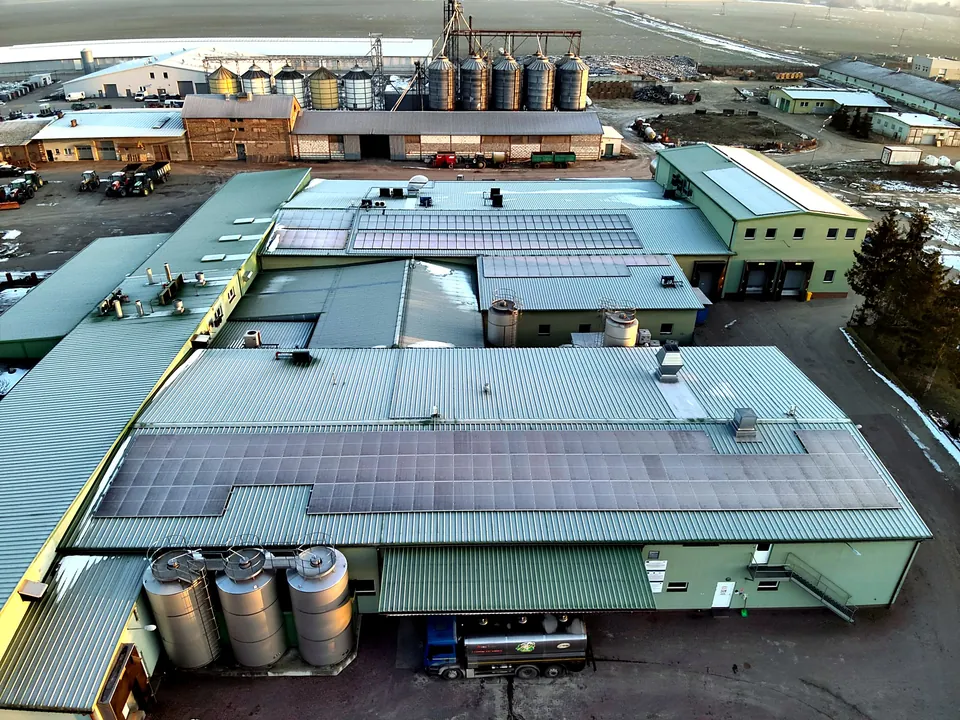
200 kWp + 261 kWh battery storage · 2025
The plant where we expanded the PV system and added a 125 kW / 261 kWh battery. The scope covered design, approvals, telecontrol, installation and acceptance. The photograph shows the site and its PV system.
View project details (in Polish)Do you have a 15-minute load profile or invoices? That is a good place to start.
Book a free Energy Review →We collect a full year of 15-minute data, invoices and data on the grid connection, the PV system and critical circuits. We agree business and technical priorities.
We simulate peak shaving, arbitrage, self-consumption, selected backup functions and available grid services separately, then check how they can be combined.
AC or DC, cabinet or container. We check the DSO’s grid connection conditions, fire safety requirements and the formalities in Poland: entry in the system operator’s register and, where required, a licence from the Energy Regulatory Office (URE).
Foundations, grid connection, installation, and integration of the power conversion system (PCS) and EMS with the meter and the PV system. Delivered by .KWARTZ Construction.
Configuring operating priorities, functional tests, tuning and integration with the plant’s supervisory system.
Performance monitoring, degradation reports against the warranty, adjustments to the operating strategy and planning for any augmentation.
We start with the purpose of the battery and the plant’s 15-minute load profile. PV energy can supply the plant directly. Depending on the goal and site conditions, surplus can go to the BESS. The EMS controls the flows on the basis of current generation, consumption, constraints and the agreed operating scenario.
Companies we have worked for








It can, if the 15-minute load profile confirms value from peak shaving, price arbitrage, selected backup functions or available grid services. Price differences alone do not settle it: efficiency, degradation, financing costs, grid connection conditions and the way the plant operates also count.
Yes. We size storage for the site’s 15-minute load profile and existing PV system, then check the connection point, switchboard capacity and the DSO’s requirements. At the Danmis plant, 200 kWp of PV works with battery storage rated at 125 kW and 261 kWh.
Not automatically. Supplying selected circuits needs a suitable architecture, dedicated circuits for the critical loads, switching, controls and an agreed backup time. This matters especially in processes covered by HACCP or GMP, where even a short interruption can mean a lost batch. A standard grid-connected battery is not, by definition, a UPS and does not guarantee that micro-interruptions are eliminated.
Battery storage with a total installed power above 10 MW requires a licence from the President of Poland’s Energy Regulatory Office (URE). Systems above 50 kW must also be entered in the register maintained by the relevant system operator, including systems that require a licence. The register kept by PSE, the Polish transmission system operator, applies to storage connected to the transmission grid. We check the formalities for the actual connection and configuration, under Article 32(1)(2) and Article 43g of the Polish Energy Law.
Safety comes from the whole design: cell technology, thermal propagation test results, separation into fire zones, detection, ventilation, controls, location and the emergency response plan. UL 9540A is a test method and NFPA 855 a US installation standard; we apply them as the project, the certified fire safety expert and the insurer require, rather than presenting them as automatic Polish certification.
BESS stands for Battery Energy Storage System: battery cells, a power converter, a battery management system (BMS), an energy management system (EMS) and fire protection measures in one installation.
We recommend a configuration only if it holds up technically and financially.
Prefer to describe it in more detail? Full contact form → Talk to an engineerBattery sizing and delivery are led by named .KWARTZ engineers. Meet the team.